
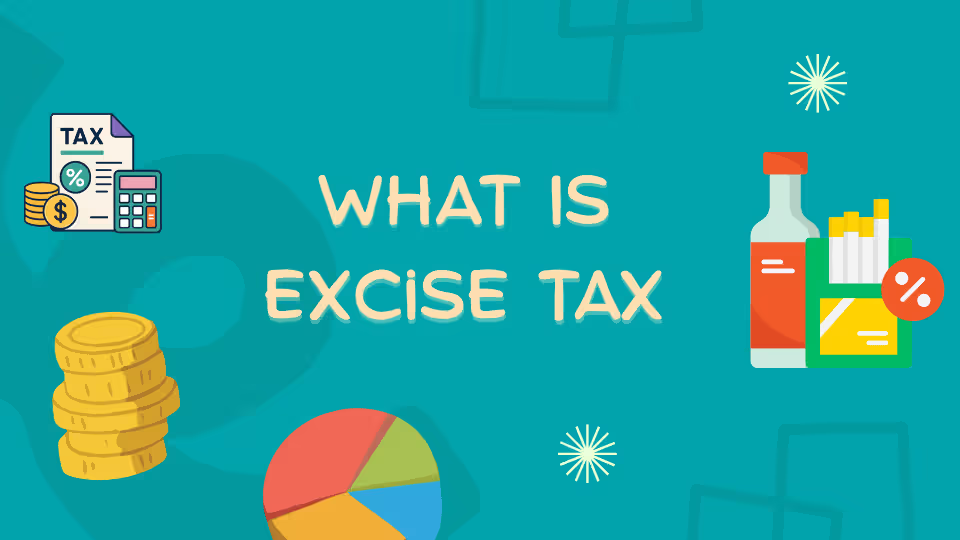

An excise tax is a tax imposed on specific goods, services, or activities rather than on a person’s total income or the overall value of a purchase. In the United States, excise taxes commonly apply to products and activities such as gasoline, diesel fuel, tobacco, alcohol, certain firearms, air travel, and heavy highway vehicles.
Unlike a general sales tax, which may apply to many products purchased by consumers, an excise tax targets particular items or transactions. The business that manufactures, sells, imports, or provides a taxable product or service may be responsible for reporting and paying the tax. The cost can also be passed on to customers through higher prices.
This article explains what excise tax means, how it works, who pays it, common examples, federal and state excise taxes, filing requirements, and the difference between excise tax and sales tax.
Must Read: What Is Tax Evasion? Meaning, 8 Common Examples, Laws & Penalties
What Is Excise Tax in Simple Terms?
Excise tax is a tax charged on particular products, services, or activities identified by law. Governments use it to collect revenue from specific transactions and, in some cases, discourage the use of products associated with public health or environmental costs.
For example, when a customer buys gasoline, the price generally includes federal and state fuel taxes. The customer pays the tax as part of the purchase price, while fuel producers, distributors, or other businesses in the supply chain may have the legal responsibility to report and pay the applicable tax.
Excise taxes can be imposed at different stages, including:
- When a manufacturer produces or sells a taxable product.
- When an importer brings a taxable product into the United States.
- When a retailer sells a taxable item.
- When a customer uses a taxable product or service.
- When a person participates in a specific taxable activity.
The exact taxable event depends on the law governing that particular excise tax.
How Does Excise Tax Work?
Excise tax usually applies to a specific product, service, or activity. The government sets the tax rate and identifies the person or business responsible for collecting, reporting, or paying it.
The tax may be calculated as a fixed amount per unit, a percentage of the sale price, or another method defined by law.
For example, suppose a federal excise tax of 18.4 cents applies to each gallon of gasoline. A fuel transaction involving 100 gallons would carry $18.40 in federal excise tax, before considering any state or local fuel taxes.
The customer may not see the federal excise tax as a separate charge at the pump. The tax is generally included in the fuel’s price.
A Simple Excise Tax Example
Imagine a manufacturer sells a taxable product for $100. The law imposes a 10% excise tax on the product.
| Description | Amount |
|---|---|
| Product price before excise tax | $100 |
| Excise tax rate | 10% |
| Excise tax | $10 |
| Price after excise tax | $110 |
In this simplified example, the tax is $10. The business may be legally responsible for reporting and paying it, while the customer pays the higher price.
Actual excise tax calculations can differ. Some taxes apply to quantities rather than prices, and some are imposed at a different point in the supply chain.
Who Pays Excise Tax?
The person legally responsible for an excise tax depends on the specific tax law. It may be a manufacturer, importer, wholesaler, retailer, service provider, or consumer.
However, the person who legally pays the tax to the government may not be the person who ultimately bears its economic cost.
For example:
- A fuel distributor may be legally responsible for paying a federal fuel tax.
- An airline may collect certain transportation taxes from passengers and remit them to the government.
- A tobacco manufacturer may owe an excise tax on taxable products.
- A customer may pay the economic cost through the product’s final price.
This distinction is important. A tax can be legally imposed on a business but economically passed on to consumers.
Common Types of Excise Taxes in the United States
The federal government imposes excise taxes on many goods, services, and activities. State and local governments also impose their own excise taxes.
Here are some common examples.
1. Fuel Excise Tax
Fuel excise tax is one of the best-known examples. Federal and state governments tax certain fuels, including gasoline and diesel.
The federal gasoline excise tax is generally 18.4 cents per gallon. The federal tax on diesel fuel is generally 24.4 cents per gallon. These rates do not include state fuel taxes or other applicable charges.
Fuel taxes help fund transportation infrastructure and related programs. Federal gasoline and diesel taxes are important sources of revenue for the Highway Trust Fund.
Example: If a driver purchases 15 gallons of gasoline, the federal gasoline excise tax included in the fuel transaction is:
15 gallons × $0.184 = $2.76
This example excludes state and local fuel taxes.

2. Tobacco Excise Tax
The federal government imposes excise taxes on several tobacco products, including cigarettes, cigars, chewing tobacco, snuff, and other taxable tobacco products.
Manufacturers and importers generally have federal tax responsibilities for covered tobacco products. The tax may be based on the number of cigarettes, product weight, or another statutory measure.
States and local governments may impose additional tobacco taxes.
Tobacco taxes generate government revenue and are also used as a public health policy tool because higher prices can discourage tobacco use.
3. Alcohol Excise Tax
Federal excise taxes apply to alcoholic beverages such as beer, wine, and distilled spirits.
The tax rates vary according to the type of beverage, alcohol content, production volume, and applicable tax rules.
For example, beer, wine, and distilled spirits do not all have the same federal excise tax rate. Eligible producers may qualify for reduced rates under certain conditions.
Businesses involved in producing, importing, or distributing alcoholic beverages must understand the applicable federal and state requirements.
4. Airline Ticket Excise Tax
The federal government imposes taxes on certain air transportation payments.
Passengers may pay taxes associated with domestic air travel, international air travel, and other taxable aviation services.
Airlines and other responsible parties generally collect and remit applicable taxes.
The amount can depend on the type of trip, the number of taxable flight segments, and the year. Certain aviation tax amounts are adjusted periodically.
5. Heavy Highway Vehicle Use Tax
The federal government imposes a Heavy Highway Vehicle Use Tax on certain heavy vehicles used on public highways.
The tax generally applies to highway motor vehicles with a taxable gross weight of 55,000 pounds or more.
Owners or other responsible persons generally report this tax using Form 2290, Heavy Highway Vehicle Use Tax Return.
The tax amount depends on the vehicle’s taxable gross weight and applicable rules. Certain vehicles and uses may qualify for exemptions or special treatment.
6. Indoor Tanning Excise Tax
Federal law imposes a 10% excise tax on certain indoor tanning services.
The service provider generally collects the tax from customers and reports it to the IRS.
The tax applies to covered indoor tanning services, not automatically to every beauty, spa, or skin-care service.
7. Tire Excise Tax
Certain tires sold by manufacturers or importers are subject to federal excise tax.
The tax generally depends on the tire’s rated load capacity and the applicable statutory calculation.
This tax is part of the federal excise tax system for specified manufactured products.
8. Firearms and Ammunition Excise Tax
Federal law imposes excise taxes on certain firearms and ammunition manufactured in or imported into the United States.
The rates depend on the category of firearm or ammunition. Manufacturers and importers generally have the responsibility to report and pay the applicable tax.
This tax is separate from other federal, state, or local rules that may regulate firearms.
9. Sports Fishing and Archery Equipment Excise Tax
Certain fishing and archery equipment is subject to federal excise tax.
Covered products can include fishing rods, fishing tackle, bows, arrows, and other specified equipment.
Manufacturers, producers, and importers generally pay the applicable tax. Revenue from these taxes helps support wildlife restoration and conservation programs.
10. Wagering and Gambling Excise Taxes
Federal excise taxes apply to certain wagering activities.
The tax rules can depend on the type of wager and the business accepting it. Businesses subject to these rules may also have registration and occupational tax requirements.
Forms 730 and 11-C are used for certain federal wagering and occupational tax obligations.
11. Excise Tax on Certain Remittance Transfers
A new federal excise tax applies to certain remittance transfers made after December 31, 2025.
The tax rate is 1% of the amount of a covered transfer. It does not automatically apply to every international bank transfer or every way of sending money abroad. The statutory definitions, payment method, provider, and applicable exceptions determine whether a transfer is covered.
The remittance transfer provider generally has collection, deposit, and reporting responsibilities under the applicable rules.
Because this is a newer tax, anyone who sends or processes international remittances should check the current IRS instructions and the provider’s disclosures.
Federal Excise Tax vs. State Excise Tax
Excise taxes can be imposed at both the federal and state levels. Some local governments also impose taxes on specific products or services.
Federal excise taxes are established under federal law and generally reported to the IRS. State excise taxes are established under state law and administered by the relevant state tax authority.
For example, gasoline purchases may include federal and state fuel taxes. Alcohol and tobacco products may also carry both federal and state excise taxes.
| Comparison | Federal Excise Tax | State Excise Tax |
|---|---|---|
| Government authority | U.S. federal government | State government |
| Main tax authority | IRS and other federal agencies, depending on the tax | State revenue or tax department |
| Examples | Federal fuel, tobacco, alcohol, and airline taxes | State fuel, tobacco, alcohol, and lodging taxes |
| Tax rates | Set by federal law | Vary by state |
| Reporting | Federal forms and procedures | State-specific forms and procedures |
| Geographic application | Federal jurisdiction | Applicable state jurisdiction |
A business may need to comply with both federal and state excise tax requirements for the same product or transaction.
Excise Tax vs. Sales Tax: What Is the Difference?
Excise tax and sales tax are both transaction-related taxes, but they apply differently.
A general sales tax usually applies to a broad range of taxable retail purchases. An excise tax applies only to particular products, services, or activities identified by law.
For example, a state may charge sales tax on clothing, electronics, and household goods. It may also impose a separate excise tax on gasoline, tobacco, or alcohol.
| Comparison | Excise Tax | Sales Tax |
|---|---|---|
| Tax base | Specific goods, services, or activities | Broad range of taxable retail sales |
| Application | Applies to selected items or transactions | Applies to taxable purchases under state or local law |
| Calculation | Per unit, percentage, or another statutory method | Usually a percentage of the taxable sale price |
| Responsible party | Depends on the specific excise tax | Usually collected by the retailer |
| Common examples | Fuel, tobacco, alcohol, airline travel | Clothing, furniture, electronics |
| Government level | Federal, state, and sometimes local | Primarily state and local in the U.S. |
Can a Purchase Have Both Excise Tax and Sales Tax?
Yes. A purchase may be subject to both taxes if the applicable laws require them.
For example, a customer buying a taxable product may pay a state sales tax while the product’s price also reflects a federal or state excise tax imposed earlier in the supply chain.
The exact treatment depends on the product and state law. Some states include certain excise taxes in the sales tax calculation, while other rules may apply.
Why Does the Government Impose Excise Taxes?
Governments use excise taxes for several reasons. They can raise revenue, support public programs, and influence consumer behavior.
1. To Raise Government Revenue
Excise taxes provide revenue for federal, state, and local governments.
For example, federal fuel taxes help support transportation-related spending. Tobacco and alcohol taxes also provide revenue for public budgets.
2. To Fund Specific Programs
Some excise tax revenue is directed to dedicated funds.
Examples include:
- Highway and transportation infrastructure.
- Airport and aviation-related programs.
- Wildlife restoration and conservation.
- Other programs specified by law.
Not every excise tax is dedicated to a particular program. Some revenue goes into general government funds.
3. To Discourage Certain Activities
Governments sometimes use excise taxes to increase the cost of products or activities that may create public health or environmental costs.
Tobacco taxes are a common example. Higher prices can discourage consumption, particularly among price-sensitive consumers.
4. To Account for Public Costs
Certain products and activities can create costs that affect the wider community.
Fuel taxes, for example, help fund road infrastructure used by motorists and commercial vehicles.
This is one reason excise taxes are sometimes designed around the quantity of a product used rather than its retail price.
How Is Excise Tax Calculated?
Excise tax is calculated according to the method specified in the law. There is no single calculation method for every type of excise tax.
Three common methods are:
1. Per-Unit Excise Tax
A fixed amount is charged for each unit of a product.
Example:
A fuel tax is $0.184 per gallon. A customer purchases 50 gallons.
50 × $0.184 = $9.20
The federal excise tax amount in this example is $9.20.
2. Percentage-Based Excise Tax
The tax is calculated as a percentage of the taxable sale price or another statutory amount.
Example:
A taxable service costs $200, and the excise tax rate is 10%.
$200 × 10% = $20
The excise tax is $20.
3. Weight, Volume, or Other Measurement-Based Tax
Some excise taxes use a product’s weight, volume, capacity, or another measurement.
For example, certain tobacco and tire taxes depend on product quantities or specifications.
The applicable calculation must follow the relevant tax instructions.
How Do Businesses Report and Pay Federal Excise Tax?
Businesses responsible for federal excise taxes must follow the reporting and payment requirements for the specific tax.
Many federal excise taxes are reported using Form 720, Quarterly Federal Excise Tax Return. However, some taxes use separate forms or reporting systems.
Form 720: Quarterly Federal Excise Tax Return
Businesses generally use Form 720 to report applicable federal excise tax liabilities.
The return covers a calendar quarter. The usual filing deadlines are:
| Quarter | Period Covered | Due Date |
|---|---|---|
| First Quarter | January to March | April 30 |
| Second Quarter | April to June | July 31 |
| Third Quarter | July to September | October 31 |
| Fourth Quarter | October to December | January 31 |
If a deadline falls on a Saturday, Sunday, or legal holiday, the IRS generally allows filing on the next business day.
Some excise taxes also require deposits before the quarterly return is due. Businesses should check the deposit rules for each tax rather than assuming that payment is due only when Form 720 is filed.
Form 2290: Heavy Highway Vehicle Use Tax
Businesses and vehicle owners subject to the Heavy Highway Vehicle Use Tax generally use Form 2290.
The form reports the tax for qualifying heavy highway vehicles. The filing period and deadline depend on the vehicle’s first use during the tax period.
Other Excise Tax Forms
Depending on the activity, additional forms may be required.
| Form | Purpose |
|---|---|
| Form 720 | Quarterly federal excise taxes |
| Form 2290 | Heavy Highway Vehicle Use Tax |
| Form 730 | Monthly tax return for certain wagers |
| Form 11-C | Occupational tax and registration for wagering |
| Form 8849 | Claim for refund of certain excise taxes |
| Form 720-X | Amended Quarterly Federal Excise Tax Return |
Not every business needs to file all these forms. The required form depends on the taxable activity.
What Happens If a Business Does Not Pay Excise Tax?
A business that fails to collect, report, deposit, or pay an excise tax when required may face financial penalties and interest.
The consequences depend on the tax involved and the nature of the violation.
Possible consequences include:
- Failure-to-file penalties.
- Failure-to-pay penalties.
- Failure-to-deposit penalties.
- Interest on unpaid tax.
- Additional assessments after an IRS examination.
- Personal liability for certain responsible persons.
For some collected taxes, the IRS may apply the Trust Fund Recovery Penalty to responsible persons who willfully fail to collect, account for, or pay over the tax.
Businesses should maintain accurate records and use the correct filing schedule to avoid unnecessary penalties.
Are Excise Taxes Deductible?
The tax treatment of an excise tax depends on the taxpayer, the type of tax, and the purpose of the expense.
For businesses, certain excise taxes paid or incurred in carrying on a trade or business may be deductible under applicable federal tax rules. However, special provisions, credits, and limitations can apply.
For individual consumers, excise taxes included in the price of personal purchases generally do not create a separate federal income tax deduction.
A business should not assume that every excise tax is deductible. It should review the specific tax and the rules governing the underlying business expense.
What Is the Difference Between Excise Tax and Income Tax?
Excise tax and income tax apply to different tax bases.
Income tax is generally based on taxable income earned by individuals or businesses. Excise tax applies to specific goods, services, or activities.
| Comparison | Excise Tax | Income Tax |
|---|---|---|
| What is taxed? | Selected goods, services, or activities | Taxable income |
| Who may pay? | Manufacturers, importers, sellers, service providers, or consumers | Individuals and businesses with taxable income |
| Calculation | Per unit, percentage, or another statutory method | Based on taxable income and applicable tax rates |
| Examples | Fuel, alcohol, tobacco, air travel | Wages, business profits, investment income |
| Reporting | Often Form 720 or another excise tax form | Forms such as 1040, 1120, or 1065, depending on taxpayer |
A business can have both income tax and excise tax responsibilities. Paying one does not automatically satisfy the other.
Is Excise Tax Included in the Price?
In many cases, yes. Excise tax is often included in the final price of a product or service.
For example, gasoline prices generally reflect fuel taxes. Customers may also pay taxes on airline tickets as part of the total fare.
However, the way a tax appears on a receipt or invoice depends on the product, business, and applicable law.
Some businesses show taxes as separate line items. Others include the tax in the advertised or displayed price.
The fact that a customer does not see a separate excise tax line does not mean that no excise tax applies.
Key Facts About Excise Tax
| Topic | Explanation |
|---|---|
| Meaning | Tax on specific goods, services, or activities |
| Tax type | Generally an indirect tax |
| Tax calculation | Per unit, percentage, or another statutory method |
| Federal tax authority | IRS for many federal excise taxes |
| Common products | Fuel, tobacco, alcohol, tires, and certain firearms |
| Common services | Air transportation and indoor tanning |
| Main federal reporting form | Form 720 for many excise taxes |
| Other forms | Form 2290, Form 730, Form 11-C, and others |
| Government levels | Federal, state, and local |
| Consumer impact | Often reflected in the final purchase price |
Frequently Asked Questions About Excise Tax
What is excise tax in simple words?
Excise tax is a tax charged on specific products, services, or activities. Common examples include gasoline, tobacco, alcohol, airline travel, and certain vehicles. The tax is often paid by a business and included in the final price customers pay.
Who is responsible for paying excise tax?
The legally responsible party depends on the specific tax law. It may be a manufacturer, importer, retailer, service provider, or consumer. In many cases, businesses collect or pay the tax and pass some or all of its economic cost to customers.
What are common examples of excise tax?
Common examples include federal gasoline and diesel taxes, tobacco taxes, alcohol taxes, airline transportation taxes, heavy highway vehicle use tax, tire taxes, and certain indoor tanning taxes. State governments also impose excise taxes on selected products and services.
What is the difference between excise tax and sales tax?
Excise tax applies to specific goods, services, or activities, while sales tax generally applies to a wider range of taxable retail purchases. Both can apply to the same transaction, depending on federal, state, and local tax laws.
Is excise tax a direct or indirect tax?
Excise tax is generally considered an indirect tax because the legal responsibility to pay it may belong to a manufacturer, seller, or service provider, while consumers may bear the cost through higher prices. The exact economic burden depends on market conditions.
Do businesses need to file Form 720 for excise tax?
Businesses liable for federal excise taxes listed on Form 720 generally use it to report those taxes quarterly. Some excise taxes require different forms, such as Form 2290 for heavy highway vehicles. Filing and deposit requirements depend on the specific tax.
Also Read: How to Start a Tax Preparation Business: IRS Requirements, Costs and Steps
Final Thoughts
Excise tax is an important part of the U.S. tax system. It applies to selected goods, services, and activities, including fuel, tobacco, alcohol, air transportation, and heavy vehicles. Unlike a general sales tax, it targets specific transactions identified by federal, state, or local law.
Businesses may have the legal responsibility to collect, report, and pay excise taxes, while consumers often bear some of the cost through higher prices. The rules and tax rates vary according to the product, service, and location.
If you operate a business that sells, imports, manufactures, or provides taxable goods or services, identify the excise taxes that apply to your activities. Maintain accurate records, follow the correct filing schedule, and consult a qualified tax professional when the rules are unclear.



Leave a Comment