
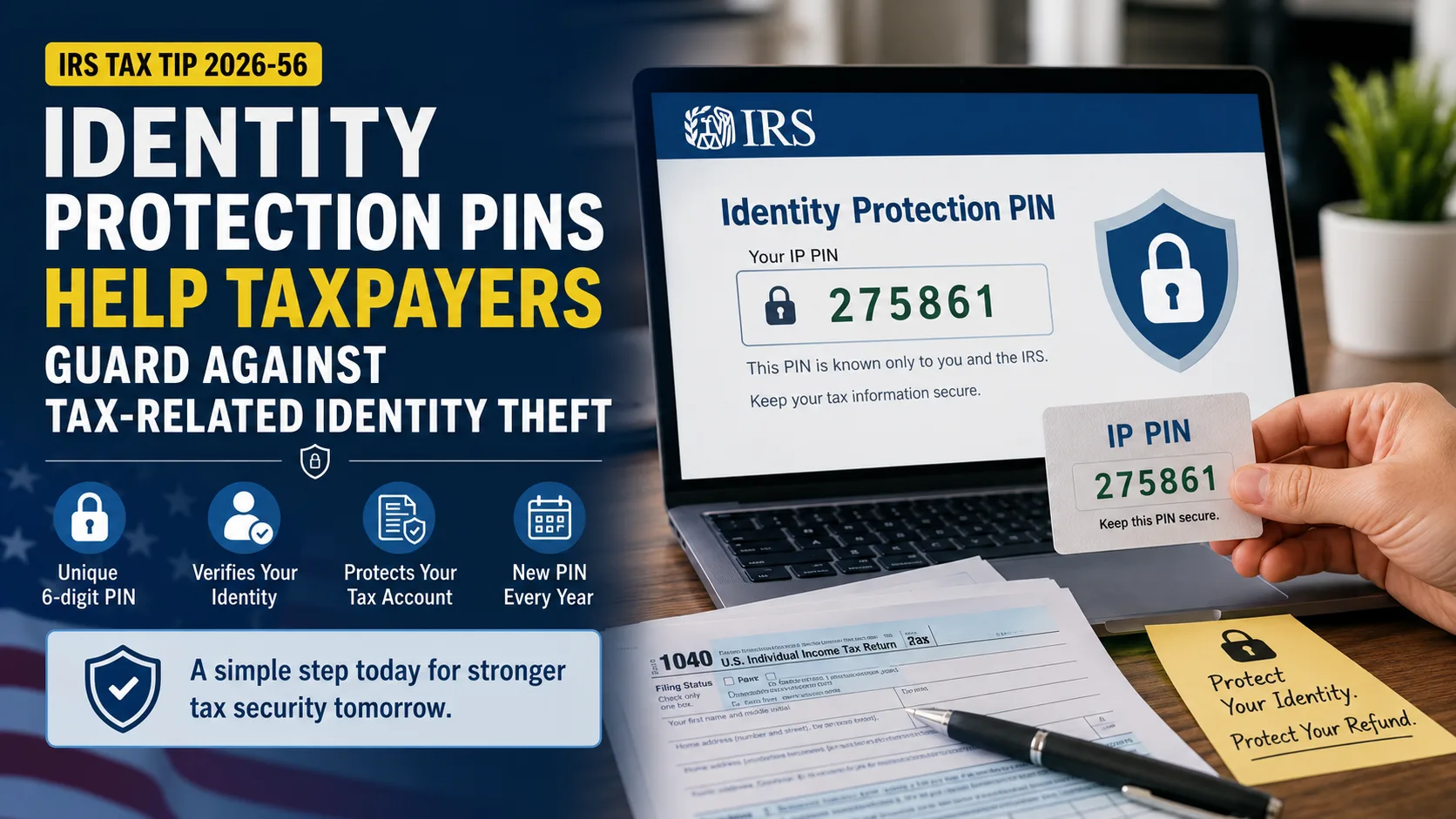

The IRS reminds taxpayers that Identity Protection PINs help taxpayers guard against tax-related identity theft by adding a unique six digit code to every federal tax return. Anyone with a Social Security number or ITIN can request a free IP PIN after identity verification.
IRS Urges Taxpayers to Use Free IP PIN for Better Tax Account Security
Tax season brings more scams and fraud attempts each year. The IRS says Identity Protection PINs help taxpayers guard against tax-related identity theft by adding an extra security step before a federal tax return is accepted. A free Identity Protection PIN, called an IP PIN, helps confirm that the return belongs to the correct taxpayer. The six digit number changes every year and is known only to the taxpayer and the IRS.
The IRS encourages eligible taxpayers to request an IP PIN before filing a federal tax return. Anyone with a Social Security number or an Individual Taxpayer Identification Number can request one after completing identity verification. The program is open to taxpayers living in the United States and abroad.
Also Read: Family Employee Tax Exemption – What Business Owners Should Know
IRS Tax Tip 2026-56 Highlights the Value of an IP PIN
The IRS released Tax Tip 2026-56 on July 16, 2026, to remind taxpayers about the value of the Identity Protection PIN program.
The agency explains that an IP PIN helps:
- Confirm a taxpayer’s identity.
- Stop many fraudulent tax return filings.
- Protect taxpayer accounts even if no return must be filed.
- Add another layer of account security.
- Reduce the risk of tax refund fraud.
The IRS also reminds taxpayers that it will never ask for an IP PIN by phone, email, text message, or social media.
What Is an Identity Protection PIN?
An Identity Protection PIN is a unique six digit number issued by the IRS. Only the taxpayer and the IRS know this number.
The IP PIN must be entered when filing a federal tax return. Without the correct number, the IRS may reject an electronically filed return or delay processing of a paper return until identity checks are complete.
Each year, the IRS creates a new IP PIN. Taxpayers who enroll online must retrieve the latest number each year, usually beginning in mid to late January.
Who Can Request an IP PIN?
The IRS allows many taxpayers to request an IP PIN.
Eligible people include:
- Individuals with a Social Security number.
- Individuals with an Individual Taxpayer Identification Number.
- Taxpayers living outside the United States.
- People who file tax returns.
- People who do not have a filing requirement but still want account protection.
The IRS requires identity verification before issuing an IP PIN.
Key Facts About Identity Protection PINs
| Feature | IRS Information |
|---|---|
| Cost | Free |
| Length | Six digit number |
| Validity | One tax year |
| Available To | SSN and ITIN holders |
| Identity Check Required | Yes |
| Changes Every Year | Yes |
| Used On | Federal tax returns, amended returns, prior year returns |
| Shared With | Only taxpayer and IRS |
Why the IRS Recommends an IP PIN
Identity theft remains one of the biggest concerns during tax filing season. Criminals may try to file fake tax returns using stolen personal information.
Identity Protection PINs help taxpayers guard against tax-related identity theft because the IRS checks the six digit number before accepting a return.
Benefits include:
- Better protection against fraudulent tax returns.
- Added security for taxpayer records.
- Greater confidence during tax filing.
- Protection even if no return is required.
- Annual renewal for stronger account security.
How to Get an IP PIN Online
The IRS says the fastest method is through an IRS Individual Account.
The process includes:
- Sign in to an IRS Individual Account.
- Complete identity verification if needed.
- Open the profile section.
- Select the IP PIN option.
- Save the issued IP PIN for future filing.
Taxpayers who already have an online account can usually complete the process quickly after signing in.
What If You Cannot Verify Your Identity Online?
The IRS provides other options for taxpayers who cannot complete online identity verification.
Form 15227
Eligible taxpayers may apply using Form 15227 if:
- Individual adjusted gross income is below $84,000.
- Married filing jointly adjusted gross income is below $168,000.
The IRS reviews the application and completes identity verification before issuing an IP PIN.
Taxpayer Assistance Center
Some taxpayers may need an in person appointment.
This option is available for people who:
- Cannot verify identity online.
- Cannot verify identity by phone.
- Cannot use Form 15227.
- Experience technical problems.
After identity verification, the IRS issues the IP PIN.
Tax Professionals and IP PINs
Tax professionals cannot request an IP PIN for clients.
However, tax preparers may use the IP PIN that a taxpayer provides while preparing and filing a federal tax return.
Taxpayers should keep the number private and provide it only when needed for filing.
Annual Renewal Matters
Many taxpayers forget that the IRS issues a new IP PIN every year.
Important reminders include:
- Retrieve the new IP PIN every January.
- Do not reuse the previous year’s number.
- Store the current number in a safe place.
- Use the correct number on every federal return filed that year.
Because Identity Protection PINs help taxpayers guard against tax-related identity theft, using the newest annual number is important for continued protection.
Returns That Require an IP PIN
Taxpayers who receive an IP PIN must include it on:
- Current year federal tax returns.
- Prior year federal tax returns filed later.
- Amended federal tax returns.
Missing the IP PIN may delay processing or cause electronic filing issues.
Common Mistakes Taxpayers Should Avoid
Many filing delays happen because taxpayers make simple errors.
Avoid these mistakes:
- Forgetting to enter the IP PIN.
- Using last year’s IP PIN.
- Sharing the IP PIN with unknown people.
- Responding to scam emails asking for the number.
- Waiting until filing day to retrieve the current IP PIN.
IRS Scam Warning
The IRS clearly states that it does not contact taxpayers by:
- Phone calls requesting an IP PIN.
- Emails requesting an IP PIN.
- Text messages requesting an IP PIN.
- Social media messages requesting an IP PIN.
If someone requests your IP PIN through these methods, it is a scam attempt.
How an IP PIN Helps Stop Tax Fraud
Fraudsters often try to submit fake tax returns before legitimate taxpayers file.
Because Identity Protection PINs help taxpayers guard against tax-related identity theft, the IRS checks the unique six digit code before processing the return. Without the correct number, a criminal has a much harder time filing a false return using stolen personal information.
This added verification helps reduce refund fraud and protects taxpayer accounts.
IP PIN Eligibility at a Glance
| Requirement | Details |
|---|---|
| Social Security Number | Eligible |
| Individual Taxpayer Identification Number | Eligible |
| Lives Outside the United States | Eligible |
| Identity Verification | Required |
| Online Application | Available |
| Form 15227 Option | Available for eligible income limits |
| In Person Appointment | Available if needed |
Important Facts Every Taxpayer Should Remember
Identity Protection PINs help taxpayers guard against tax-related identity theft through a simple but effective security process.
Remember these points:
- The IP PIN is free.
- The number changes every year.
- Identity verification is required.
- The IRS never asks for the number through phone, email, text, or social media.
- Use the current IP PIN on every federal return filed during the year.
- Retrieve a new number each January if enrolled online.
Why More Taxpayers Are Choosing an IP PIN
Tax related identity theft can create delays, refund problems, and added paperwork.
Many taxpayers now request an IP PIN before problems happen. Since Identity Protection PINs help taxpayers guard against tax-related identity theft, the program gives taxpayers another security step without any fee.
The annual renewal process also means each year’s code remains current, making unauthorized filing more difficult.
FAQs
What is an Identity Protection PIN?
An Identity Protection PIN is a free six digit number issued by the IRS after identity verification. Taxpayers include this number when filing federal tax returns. The number confirms the taxpayer’s identity and helps reduce the chance of fraudulent tax returns using stolen personal information.
Who can request an Identity Protection PIN?
Anyone with a Social Security number or an Individual Taxpayer Identification Number may request an IP PIN after completing identity verification. The program is also available to taxpayers who live outside the United States and even to people who are not required to file tax returns.
How do I get an IP PIN from the IRS?
The fastest option is through an IRS Individual Account after identity verification. Eligible taxpayers who cannot complete the online process may qualify to submit Form 15227 or schedule an appointment at a Taxpayer Assistance Center for in person identity verification.
Does the IRS issue a new IP PIN every year?
Yes. The IRS creates a new IP PIN each year. Taxpayers who use the online system should retrieve their current year’s number beginning in mid to late January. Using an old IP PIN can cause filing problems or delays.
Can my tax preparer request an IP PIN for me?
No. Tax professionals cannot request an IP PIN for clients. After you receive your IP PIN, you may provide it to your tax preparer so they can include the correct number when preparing and filing your federal tax return.
Will the IRS ever call or email asking for my IP PIN?
No. The IRS never requests your IP PIN through phone calls, emails, text messages, or social media. Any message asking for your IP PIN through those channels should be treated as a scam attempt and ignored.
Conclusion
The IRS continues to remind taxpayers that Identity Protection PINs help taxpayers guard against tax-related identity theft by adding a secure identity check before a federal tax return is accepted. The program is free, available to eligible taxpayers, and renews each year for added protection.
Taxpayers who complete identity verification and use their annual IP PIN correctly can reduce the risk of fraudulent tax filings and help protect their IRS account from identity theft.



Leave a Comment