

WASHINGTON, D.C. The Department of the Treasury and the Internal Revenue Service released Notice 2026-48 on plans to issue proposed regulations for the Saver’s Match program. This program begins in 2027 and replaces the Saver’s Credit. The Saver’s Match gives eligible taxpayers a direct federal contribution toward their retirement savings instead of a tax credit, and the notice opens a public comment period for taxpayers, employers, and financial institutions to weigh in before the rules are finalized.
Also Read: The Estate Tax Mistake That Can Cost Families Millions
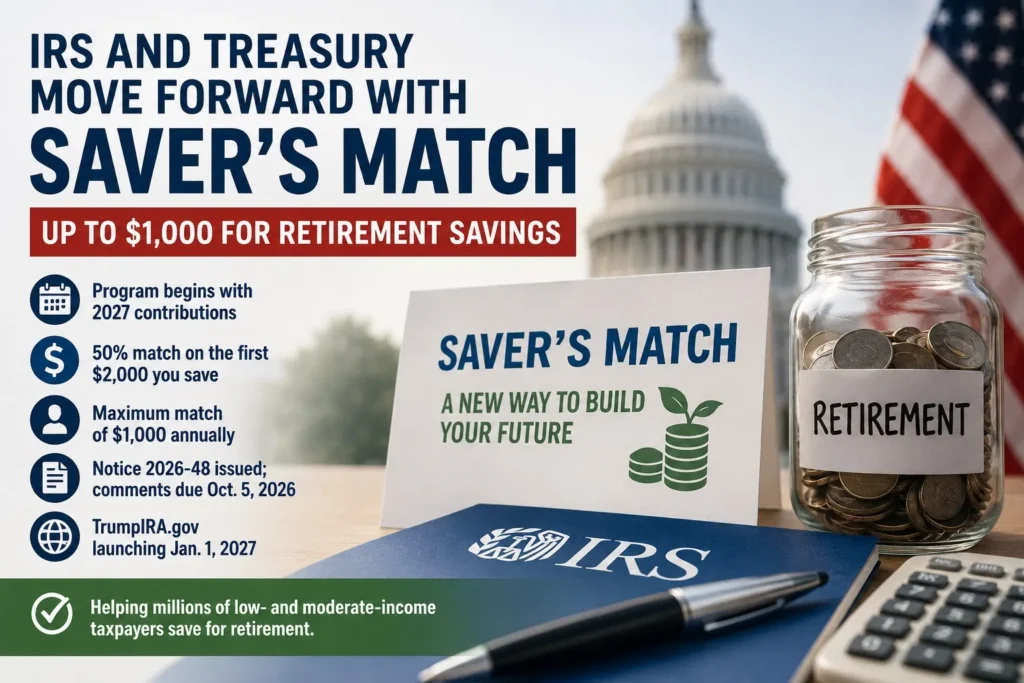
Treasury and the IRS issued Notice 2026-48, announcing plans for Saver’s Match regulations. The Saver’s Match offers a 50% federal match on retirement contributions, up to $1,000 a year, starting with 2027 contributions and paid out in 2028.
News Highlights
- Treasury and the IRS issued Notice 2026-48 to begin implementing Saver’s Match regulations.
- The Saver’s Match replaces the Saver’s Credit and matches up to 50% of the first $2,000 in retirement contributions.
- The maximum annual Saver’s Match benefit is $1,000 per eligible taxpayer.
- The program starts with 2027 contributions, with payments issued starting in 2028.
- The notice implements Executive Order 14403, which launches TrumpIRA.gov on January 1, 2027.
What Is the Saver’s Match?
The Saver’s Match is a federal program created under the SECURE 2.0 Act. It replaces the Saver’s Credit, a nonrefundable tax credit that many low-income filers could not fully use because they owed little or no federal tax. The Saver’s Match fixes that gap. Instead of a credit applied against tax owed, the government deposits money directly into the taxpayer’s retirement account, so every eligible saver receives the benefit regardless of their tax liability.
How the Saver’s Match Works
The Saver’s Match applies to contributions made to an employer-sponsored retirement plan or an IRA. Here is how the program functions:
- A taxpayer contributes to a qualified employer-sponsored retirement plan or an IRA during the 2027 tax year.
- The federal government matches up to 50% of the first $2,000 contributed.
- The maximum Saver’s Match payment is capped at $1,000 per taxpayer, per year.
- Treasury deposits the Saver’s Match contribution directly into the taxpayer’s retirement account.
- Eligible taxpayers begin receiving Saver’s Match payments in 2028, based on contributions made during 2027.
Saver’s Match Program at a Glance
| Detail | Information |
|---|---|
| Match rate | Up to 50% |
| Contributions matched | First $2,000 per year |
| Maximum annual benefit | $1,000 |
| First contribution year | 2027 |
| First payment year | 2028 |
| Replaces | Saver’s Credit |
| Legal basis | SECURE 2.0 Act |
| Public comment deadline | October 5, 2026 |
Executive Order 14403 and TrumpIRA.gov
Notice 2026-48 also begins implementing Executive Order 14403, “Promoting Retirement-Savings Access for American Workers by Establishing TrumpIRA.gov,” signed April 30, 2026. The order directs Treasury to raise public awareness of the Saver’s Match and help taxpayers access low-cost, diversified, index-based retirement savings options.
Treasury will launch TrumpIRA.gov on January 1, 2027. The site targets workers without access to an employer-sponsored retirement plan and will list financial institutions that offer IRAs, accept Saver’s Match contributions, and meet other criteria set by Treasury. The IRS expects to release more information later this year for IRA providers that want to appear on the site.
IRS Chief Executive Officer Frank Bisignano said the Saver’s Match gives millions of low- and moderate-income Americans a new way to strengthen their retirement savings. He described the notice as an early step toward putting the Executive Order’s retirement savings goals into practice.
Who Benefits from the Saver’s Match
The Saver’s Match targets workers who save the least today. These groups stand to gain the most:
- Low- and moderate-income workers who owed too little federal tax to use the full Saver’s Credit in past years.
- Part-time and hourly workers who contribute small amounts to a workplace retirement plan.
- Workers without access to an employer-sponsored plan who open an IRA instead.
- Younger workers starting their first retirement account, since even small early contributions grow over time.
- Self-employed individuals who fund a retirement account outside a traditional employer plan.
Timeline for the Saver’s Match Rollout
| Date | Milestone |
|---|---|
| April 30, 2026 | Executive Order 14403 signed |
| 2026 (current) | Notice 2026-48 issued, comment period opens |
| October 5, 2026 | Public comment deadline for Notice 2026-48 |
| January 1, 2027 | TrumpIRA.gov launches |
| 2027 tax year | First contributions eligible for Saver’s Match |
| 2028 | First Saver’s Match payments issued |
Saver’s Match vs. the Old Saver’s Credit
The Saver’s Match works differently from the credit it replaces. The table below shows the main differences taxpayers should know before 2027.
| Feature | Saver’s Credit (old) | Saver’s Match (new) |
|---|---|---|
| Benefit type | Nonrefundable tax credit | Direct deposit into retirement account |
| Value if no tax owed | Often lost or reduced | Full match still paid |
| Maximum benefit | Up to $1,000 (credit) | Up to $1,000 (match) |
| When received | Applied to tax return | Deposited the following year |
| Match rate | 10%, 20%, or 50% by income tier | Up to 50% |
The old Saver’s Credit reduced a taxpayer’s bill, but it offered no value to filers who already owed little or no federal tax. Many low-income workers who contributed to retirement accounts never saw the full benefit. The Saver’s Match removes that limit by paying eligible taxpayers directly, regardless of what they owe.
What This Means for Employers and Plan Providers
Employers and retirement plan administrators also have work to do before the Saver’s Match takes effect. Plans need the ability to receive and track Saver’s Match deposits alongside regular employee contributions. Financial institutions that want to appear on TrumpIRA.gov must meet criteria Treasury plans to release later this year, covering cost structure, investment options, and how the institution accepts Saver’s Match funds. Employers who sponsor retirement plans should watch for guidance on how Saver’s Match deposits interact with existing plan rules, since the deposits are separate from an employee’s own contribution.
What Taxpayers Should Do Now
Taxpayers do not need to take action immediately, but early preparation helps:
- Review your current retirement contributions to an employer plan or IRA.
- Check your income against upcoming Saver’s Match eligibility limits once Treasury releases them.
- Watch for updates on TrumpIRA.gov ahead of its January 2027 launch.
- Ask your employer if your retirement plan will accept Saver’s Match contributions.
- Submit comments on Notice 2026-48 before October 5, 2026, if you want input on the final rules.
Public Comment Period
Treasury and the IRS want feedback before writing final Saver’s Match regulations. Notice 2026-48 lists specific questions where the agencies want public input, including how contributions get verified and how payments reach retirement accounts. Interested taxpayers, employers, and financial institutions can submit comments through October 5, 2026, using the instructions in the notice. Public comments shape how the Saver’s Match will work once regulations become final.
Frequently Asked Questions
What is the Saver’s Match program?
The Saver’s Match is a federal program that matches up to 50% of a taxpayer’s retirement contributions, up to $1,000 a year. It replaces the Saver’s Credit and pays the match directly into the taxpayer’s retirement account instead of reducing their tax bill.
When does the Saver’s Match start?
The Saver’s Match applies to contributions made during the 2027 tax year. Treasury and the IRS will issue the first Saver’s Match payments in 2028, based on those 2027 contributions. The program does not affect returns filed for 2026 or earlier tax years.
How much money can I get from the Saver’s Match?
Eligible taxpayers can receive up to $1,000 a year. The government matches up to 50% of the first $2,000 contributed to an employer-sponsored retirement plan or an IRA. The exact match depends on income and the amount contributed.
What is TrumpIRA.gov?
TrumpIRA.gov is a Treasury website launching January 1, 2027. It helps workers without an employer retirement plan find low-cost IRAs. The site will list financial institutions that accept Saver’s Match contributions and meet criteria Treasury sets under Executive Order 14403.
Does the Saver’s Match replace the Saver’s Credit?
Yes. The Saver’s Match replaces the Saver’s Credit starting with the 2027 tax year. Unlike the credit, which only helped taxpayers who owed tax, the Saver’s Match pays eligible savers directly, so it helps taxpayers regardless of their tax liability.
Can I submit comments on the Saver’s Match regulations?
Yes. Notice 2026-48 opens a public comment period that runs through October 5, 2026. Taxpayers, employers, and financial institutions can submit feedback on proposed Saver’s Match rules using the submission instructions included in the notice.
Conclusion
The Saver’s Match marks a shift in how the federal government rewards retirement savings. Rather than a tax credit that many low-income workers could not fully claim, the Saver’s Match deposits real money into retirement accounts, starting with 2027 contributions and paid out in 2028.
Taxpayers who want a say in the final rules have until October 5, 2026, to submit comments on Notice 2026-48. Everyone else can start preparing now by reviewing their retirement contributions and watching for the TrumpIRA.gov launch in January 2027.

Leave a Comment